 Day Trips from Barcelona
Medieval Towns & Pyrenees Tours from Barcelona
Last reviewed August 2026
These are the medieval towns tours from Barcelona that reach places the railway does not: Besalú with its 11th-century fortified bridge, Santa Pau, Castellfollit de la Roca balanced on a basalt cliff, Vic's arcaded market square, and — on the third listing — a rack railway climbing into the Vall de Núria at nearly 2,000 metres. Three tours, two of them near-identical, one of them a mountain day. If any day on this site justifies paying for a guide and a vehicle, it is this one; the rest of the day trips from Barcelona are on the homepage.
Quick answer Two near-identical circuits and one mountain day
Two listings run the same four-town circuit at the same $114.65 — the eleven-hour version returns by 19:00, the twelve-hour one between 20:00 and 21:00. The third, at $136.59, trades Santa Pau and Besalú for Queralbs and a rack railway into an alpine valley. None of these places is on a direct train line from Barcelona.
Key takeaways
- Vic's market runs Tuesdays and Saturdays — book one of those and the stop changes completely
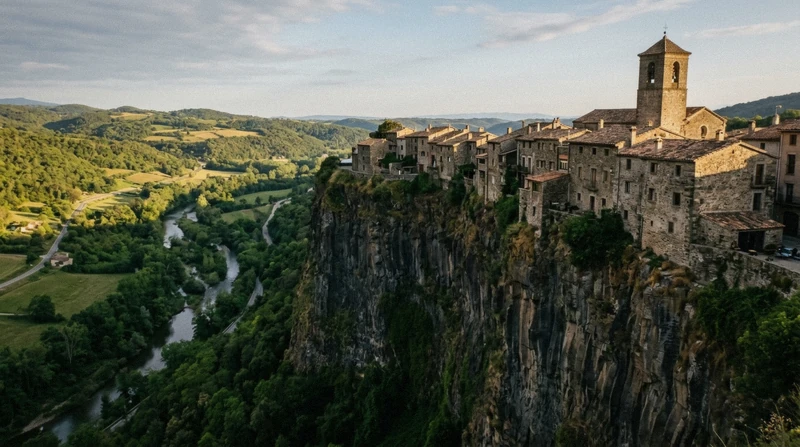
- Castellfollit de la Roca sits on a 40-metre basalt cliff; fog takes the viewpoint away
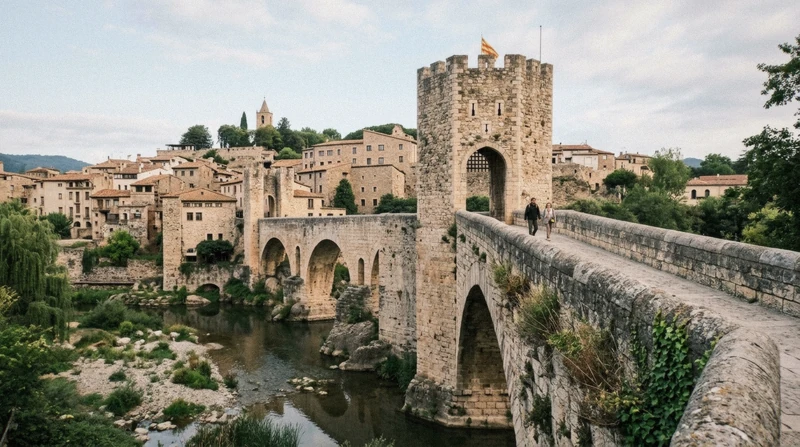
- Besalú's medieval bridge and mikveh are the highlight of the two town circuits
- The Pyrenees day closes its rack railway on November weekdays
- All three include hotel pickup or a central meeting point and cap the group at 8 to 16
The Listings Compared
Prices, ratings and review counts read from the listings in August 2026. None of these tours includes paid admissions, because the bridges, cliffs and squares they visit are free to walk into.
 from $114.65Four medieval stops
Besalú, Vic & Medieval Towns Tour from Barcelona
Vic's market square, the basalt cliff at Castellfollit de la Roca, Gothic Santa Pau and the Besalú bridge — the fullest medieval circuit here, in a…
- Cancellation
- Free cancellation 24h
- Operator
- Barcelona Y Day Trips
 from $114.65Highest rated medieval day
Besalú & Medieval Towns Day Tour from Barcelona
The same four medieval towns as its sister tour, an hour longer, and the only day on this page with a clean 5.0. Small sample —…
- Cancellation
- Free cancellation 24h
- Operator
- Barcelona Y Day Trips
 from $136.59Rack railway to 2,000 m
Pyrenees Mountains & Medieval Villages Tour
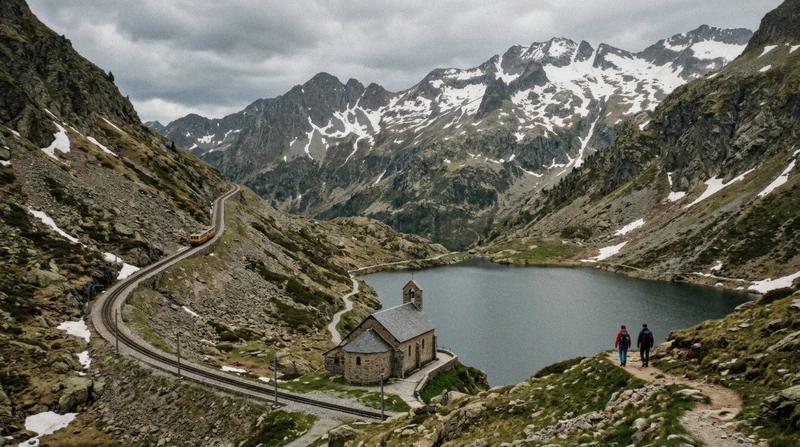
Vic's market square in the morning, the stone village of Queralbs, then the rack railway up to the Vall de Núria at nearly 2,000 metres. The…
- Cancellation
- Free cancellation 24h
- Operator
- Barcelona Y Day Trips
Which Route, and How Long a Day
The two town circuits share an operator and a price; the Pyrenees day is a different proposition entirely. Times are the operators' own.
| Tour | Price | Route | Book | Ends | Rating |
|---|---|---|---|---|---|
| [Besalú, Vic & medieval towns](/besalu-vic-medieval-towns-tour/) | $114.65 | Vic, Santa Pau, Castellfollit, Besalú | Details | 19:00 | 4.8 (12) |
| [Besalú & medieval towns, 12h](/besalu-medieval-towns-tour/) | $114.65 | Same four towns | Details | 20:00–21:00 | 5.0 (5) |
| [Pyrenees & Vall de Núria](/pyrenees-vall-de-nuria-tour/) | $136.59 | Vic, Queralbs, Vall de Núria | Details | 19:00–19:30 | 4.6 (12) |
Small samples throughout — five, twelve and twelve reviews. Read them as encouraging rather than conclusive; all three operators run these routes regularly.
The Places These Tours Reach
Five stops across three itineraries, and why each is on the route.
Besalú
The best of them. An 11th-century fortified bridge crosses the Fluvià with a gate tower standing mid-span, and behind it sits a medieval core declared a national historic-artistic monument. The Jewish quarter holds a mikveh — a ritual bath, one of very few medieval examples surviving in Europe.
An hour walks the bridge, the square and the quarter.
Castellfollit de la Roca and Santa Pau
Castellfollit is a single street of houses built to the edge of a basalt cliff dropping 40 metres to the river, formed by two lava flows in the Garrotxa volcanic zone. The photograph everyone takes is from the viewpoint across the valley, which means the stop depends entirely on visibility.
Santa Pau is smaller and quieter: a Gothic-Renaissance village you can walk end to end in twenty minutes, arcaded square included.
Vic and the Vall de Núria
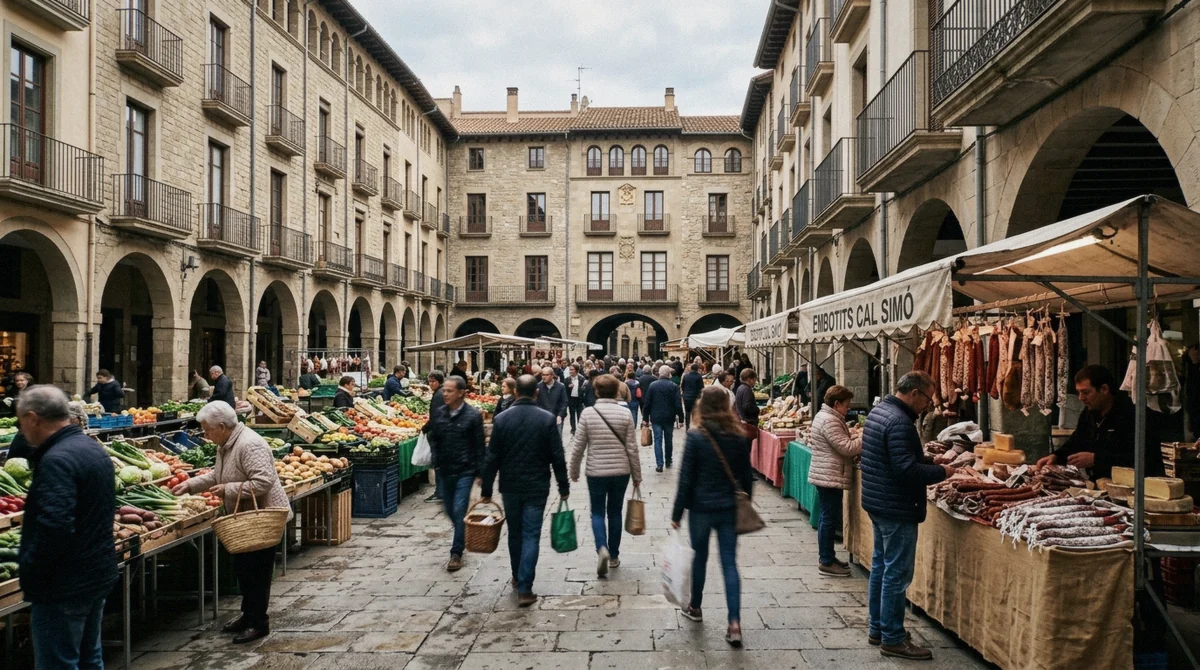
Vic appears on all three itineraries. It has a Roman temple still standing, a cathedral running from Romanesque to Neoclassical with Sert's murals inside, and one of the largest arcaded squares in Catalonia — a working market on Tuesdays and Saturdays.
Vall de Núria is on the Pyrenees day alone: a glacial bowl at just under 2,000 metres with a sanctuary, a lake and no road in. The rack railway from Queralbs is the only mechanised way up, and it is included in that tour's price.
Why There Is No Train Alternative
On most destinations this site tells you when the train is cheaper. Here it is not an option.
What independent travel would involve
Besalú has no station. Reaching it means a train to Girona and then a regional bus, which turns a day trip into most of a day in transit, and Santa Pau and Castellfollit are further along the same road with sparser services. Vic is on the R3 and is genuinely easy alone; the Vall de Núria is reachable on the R3 to Ribes de Freser and then the same rack railway the tour uses, but that is the whole day for one valley.
So the honest position is this: Vic yes, Núria at a push, the medieval towns realistically no. That is what the $114.65 is buying — not a guide you could do without, but a route you cannot assemble.
Medieval Towns & Pyrenees: Common Questions
Can I get to Besalú from Barcelona without a car?
Only awkwardly — a train to Girona and then a regional bus, which uses most of the day. There is no direct railway. That is the reason both Besalú circuits here run as guided small-group days with hotel pickup.
Which of the two Besalú tours should I book?
They are the same operator, the same four towns and the same $114.65. The eleven-hour version is home by 19:00 and is listed as wheelchair-accessible; the twelve-hour one returns between 20:00 and 21:00 and is not.
What is the Vic market day?
Tuesday and Saturday. The Plaça Major turns into one of Catalonia's oldest markets — produce, cured meats, the local llonganissa — and on other days it is an impressive but empty square. Two of the tours compared here here flag it explicitly.
Does the Pyrenees tour always use the rack railway?
No. Annual track maintenance closes the line Monday to Friday from 1 to 30 November, and on those days the tour runs a lower-altitude road itinerary instead. Weekends in November are unaffected.
What towns near Barcelona are worth visiting?
Besalú, Vic, Santa Pau and Castellfollit de la Roca are the four on these circuits, and none is reachable by direct train except Vic. Beyond them, Girona is the largest medieval city in the region and an easy 38-minute train, Tarragona has the Roman ensemble, and Sitges is the coastal option — all set out on the homepage comparison.
Are these towns busy?
Far less than Montserrat or the Costa Brava. Besalú takes coach groups in summer and can feel crowded around the bridge for an hour at midday, but Santa Pau and Castellfollit see a fraction of the traffic, and Vic on a non-market day is simply a working Catalan city going about its business.
Which is better, the medieval towns or Girona?
Girona if you want one place in depth: a complete old town, walls you can walk, El Call and the cathedral, with a train that makes it easy alone. The medieval circuit if you want variety and access to places you could not otherwise reach — four towns, none of them on a railway, in a group of eight.
What a Day on This Circuit Feels Like
Four stops, about four hours of driving and roughly an hour on foot in each town. Here is how the day actually unfolds.
Morning: Vic
Pickup runs between 08:00 and 09:00 from your accommodation, and the first stop is about ninety minutes north. Vic is a cathedral city rather than a village: a Roman temple still standing in the middle of it, a cathedral that runs from Romanesque through Gothic to Neoclassical with Josep Maria Sert's murals inside, and the Plaça Major, one of the largest arcaded squares in Catalonia.
On Tuesdays and Saturdays that square is a working market — produce, cheeses, the local llonganissa sausage — and the stop changes completely. Guides flag this, and it is the single strongest reason to pick your day of the week deliberately.
Midday: the volcanic zone
Santa Pau and Castellfollit de la Roca sit in La Garrotxa, a landscape of dormant volcanic cones and lava flows. Castellfollit's houses stand on the lip of a basalt cliff dropping 40 metres to the confluence of two rivers, and the viewpoint is across the valley — which makes this the stop that fog can take away entirely.
Santa Pau is quieter and smaller: an arcaded square, a Gothic-Renaissance core and twenty minutes to walk it end to end.
Afternoon: Besalú
The finish, and the best of the four. The bridge is 11th century, angled rather than straight, with a fortified gate tower standing mid-span. Behind it the town keeps its medieval street plan, and the Jewish quarter holds a mikveh — a ritual bath cut into the rock by the river, one of very few medieval examples left in Europe.
An hour covers the bridge, the main square and the quarter at a walk. Both circuits here end in Besalú, one returning to Barcelona by 19:00 and the other between 20:00 and 21:00.
When to Go
The towns are open year-round; what changes is the light and the volcanic-zone scenery.
Season by season
Late spring and early autumn are the best of it: the Garrotxa is green, the cliff viewpoint at Castellfollit is clear and the towns are not crowded. October and early November bring beech colour in the Fageda d'en Jordà woods nearby, which the road passes.
Winter is cold and often foggy in the river valleys, which is exactly what spoils the Castellfollit stop; the towns themselves work fine. Summer is hot on the cobbles by mid-afternoon, so the earlier departures suit better. Whatever the season, pick a Tuesday or a Saturday for the Vic market.
Booking Notes for the Medieval Circuit
Five things worth settling before you click through to the platform.
Before you book
Each of these is stated on the operator's own listing or, where marked, comes from traveller reports. Prices and terms were read in August 2026.
- Day of the week. Tuesday or Saturday puts Vic's market in the itinerary; any other day gives you the square without it.
- Which finish time. The eleven-hour circuit returns by 19:00, the twelve-hour one between 20:00 and 21:00. Same price, same route.
- Accessibility. Only the eleven-hour listing states wheelchair access; the other says it is not accessible, and all four towns are cobbled either way.
- Lunch. Not included on any of them. Vic has the most choice and the longest stop.
- Weather. Rain does not stop the towns, but fog removes the Castellfollit cliff viewpoint, which is the photograph most people come for.
Four medieval towns or an alpine valley — the places the railway misses. Check the next departures.
Prices and availability are confirmed at checkout on the booking platform.